UDL again. Flipping again. And, if you keep reading - a great Google Doc!!
Universal design's focus is that barriers to learning are removed and all students have equal access to the curriculum.
Reducing the number of students in the margins. Sounds good. Hard to argue.
The flipped classroom affords time to teachers so they can spend more time with students and have more of an opportunity to discover the barriers to learning. When you teach high school science in a full year school (one that is an IB school for example) it is hard to get to know the 200 students you teach. So time is gold.
Flipping gets you that time.
Flipping to me is way more than vodcasts. It is strategically using "out of class" activities (vodcasts, interactive simulations, screen-casts, case studies, virtual labs, etc.) to motivate students to become engaged during the "in class activities."
So some tools to assist the science teachers in the spirit of UDL and flipping can be found in this Google Doc I have started. Please comment if you can see how I can make this a better working document and share share share.......
UDL Applied and the Science Classroom: https://docs.google.com/document/d/1III6JxvJgyjzJuUr9gV2WTLfZt_HDMjICL2e-feXeeQ/edit
Wednesday, 30 May 2012

Wednesday, 23 May 2012
UDL and Science and the LECTURE
There is interest in Universal Design for Learning in our district. Principals and district leaders are initiating conversations around Universal Design. This conversation is of particular interest to me as I consider that the most frequent method of delivery of information in the secondary science classroom is the lecture.
The term "universal design" was coined by the architect Ronald L. Mace to describe the concept of designing all products and the built environment to be aesthetic and usable to the greatest extent possible by everyone, regardless of their age, ability, or status in life.
According to the Centre for Applied Special Technology (CAST), “Universal Design for Learning (UDL) is a research-based framework for designing curricula—that is, educational goals, methods, materials, and assessments—that enable all individuals to gain knowledge, skills, and enthusiasm for learning. This is accomplished by simultaneously providing rich supports for learning and reducing barriers to the curriculum, while maintaining high achievement standards for all students.”
So……back to the secondary science classroom.
Science teachers overwhelmingly agree that to successfully prepare students for the grade 12 Alberta diploma exam the only method that would seem to present itself as an option to finish the course is LECTURE. Finish the course….
Let’s look at the course.
In many Edmonton high schools, students are provided with the option to take the “regular” stream, or International Baccalaureate stream, or the Advanced Placement stream. Regardless of which stream they take, students have to be prepared for the Alberta Diploma exams based on the Alberta Program of Studies- http://education.alberta.ca/teachers/program/science/programs.aspx. So, if students are taking either of the additional programs, the amount of material required to learn is almost out of reach.
I have worked with many creative, enthusiastic science teachers that have felt beaten down by the sheer volume of content. So how does UDL help with this?
To wrap my head around it, I began by thinking about the UDL phrase, “reducing the barriers.” What barriers are there in the secondary science class? Just off the top of my head, here are a few:
• Attendance
• Punctuality
• Completed homework
• Engagement
• Prior Knowledge
• Methods of acquiring understanding
• Demonstration of understanding
• Student readiness
• Teacher readiness
• Physical Layout of the Classroom
• Social structure
UDL focuses on three main guidelines http://www.udlcenter.org/sites/udlcenter.org/files/updateguidelines2_0.pdf:
1. Provide multiple means of representation
2. Provide multiple means of action and expression
3. Provide multiple means of engagement
The CAST website http://www.cast.org/index.html offers tutorials, supports and examples of these guidelines. It’s hard to argue with the philosophy.
I’ve had many discussions with secondary science teachers who also find it hard to argue with the philosophy but at the end of the day can’t see how make this work with the demands of our reality.
I’m going to offer a beginning solution. Start slow and remember that the guidelines are just guidelines meant to guide the teacher in planning for all students in an effort to reduce the number of students in the margins.
Now let’s consider the secondary science class. If the content in the lecture was included in a vodcast, rather than lecture during class, then the teacher would have time in class for multiple means of representation, action and expression, and engagement. The vodcast could be either watched at home or if students didn't have the time, then it could be watched first thing during the class. I know from experience that the amount of time it takes me to lecture is at least doubled when I lecture in class. There are distractions, announcements, punctuality issues, behavior issues etc. that reduces the amount of “usable” time for the lecture. So, to take the lecture out of the class, affords me time I thought I never had. I could use the class time for the engaging, creative ideas that have been storming in my head! I could get to know the students way faster so that during parent teacher conferences in November, I wouldn't have to struggle remembering what the name of the child was! (Consider that high school teachers in full year schools may have 200 students).
What is this magic?
It’s called the “Flipped Classroom”. Read my last post. I’m dying to try it.
The term "universal design" was coined by the architect Ronald L. Mace to describe the concept of designing all products and the built environment to be aesthetic and usable to the greatest extent possible by everyone, regardless of their age, ability, or status in life.
According to the Centre for Applied Special Technology (CAST), “Universal Design for Learning (UDL) is a research-based framework for designing curricula—that is, educational goals, methods, materials, and assessments—that enable all individuals to gain knowledge, skills, and enthusiasm for learning. This is accomplished by simultaneously providing rich supports for learning and reducing barriers to the curriculum, while maintaining high achievement standards for all students.”
So……back to the secondary science classroom.
Science teachers overwhelmingly agree that to successfully prepare students for the grade 12 Alberta diploma exam the only method that would seem to present itself as an option to finish the course is LECTURE. Finish the course….
Let’s look at the course.
In many Edmonton high schools, students are provided with the option to take the “regular” stream, or International Baccalaureate stream, or the Advanced Placement stream. Regardless of which stream they take, students have to be prepared for the Alberta Diploma exams based on the Alberta Program of Studies- http://education.alberta.ca/teachers/program/science/programs.aspx. So, if students are taking either of the additional programs, the amount of material required to learn is almost out of reach.
I have worked with many creative, enthusiastic science teachers that have felt beaten down by the sheer volume of content. So how does UDL help with this?
To wrap my head around it, I began by thinking about the UDL phrase, “reducing the barriers.” What barriers are there in the secondary science class? Just off the top of my head, here are a few:
• Attendance
• Punctuality
• Completed homework
• Engagement
• Prior Knowledge
• Methods of acquiring understanding
• Demonstration of understanding
• Student readiness
• Teacher readiness
• Physical Layout of the Classroom
• Social structure
UDL focuses on three main guidelines http://www.udlcenter.org/sites/udlcenter.org/files/updateguidelines2_0.pdf:
1. Provide multiple means of representation
2. Provide multiple means of action and expression
3. Provide multiple means of engagement
The CAST website http://www.cast.org/index.html offers tutorials, supports and examples of these guidelines. It’s hard to argue with the philosophy.
I’ve had many discussions with secondary science teachers who also find it hard to argue with the philosophy but at the end of the day can’t see how make this work with the demands of our reality.
I’m going to offer a beginning solution. Start slow and remember that the guidelines are just guidelines meant to guide the teacher in planning for all students in an effort to reduce the number of students in the margins.
Now let’s consider the secondary science class. If the content in the lecture was included in a vodcast, rather than lecture during class, then the teacher would have time in class for multiple means of representation, action and expression, and engagement. The vodcast could be either watched at home or if students didn't have the time, then it could be watched first thing during the class. I know from experience that the amount of time it takes me to lecture is at least doubled when I lecture in class. There are distractions, announcements, punctuality issues, behavior issues etc. that reduces the amount of “usable” time for the lecture. So, to take the lecture out of the class, affords me time I thought I never had. I could use the class time for the engaging, creative ideas that have been storming in my head! I could get to know the students way faster so that during parent teacher conferences in November, I wouldn't have to struggle remembering what the name of the child was! (Consider that high school teachers in full year schools may have 200 students).
What is this magic?
It’s called the “Flipped Classroom”. Read my last post. I’m dying to try it.
Monday, 5 December 2011
To Flip or Not to Flip
I have been reading a lot about flipping high school classes. I have read that it is the next "thing" in educational technology: papyrus to flipped classroom
I would love to see this in action so I invite you to use my assignment on the light reaction of photosynthesis as a means for students to demonstrate their understanding. Here are the steps:
1. Create a webcast that teaches the light reaction. Use Screenr (http://www.screenr.com/) to make your webcast. Create a free account, buy a microphone and then use whatever website or presentation you need - where you can start and stop - to effectively teach that one topic. Must be 5 minutes or less.
2. Assign the webcast for homework along with about two reflective questions and a diagram. I think that the whole "homework" experience will be less than 10 minutes (unless the student chooses to rewind).
3. As students walk into class they will find table groupings and will sit in groups of 4-5. On each table will be the following handout. As a group they will choose which assignment they want to complete or they can move to other tables and sit with like minded individuals. You decide.
4. If students missed the homework, before they sit down they will pick up the homework assignment and watch the 5 minute lesson either on a screen, SMART board, or personal device.
5. Students begin the work.
6. You, the teacher, will facilitate the work. You will get to every group and have conversations with every student in an effort to uncover misunderstandings.
7. Depending on the time you have in your class, students will demonstrate their understanding to their classmates.
8. You will then come back to this post and comment on your successes or failures with the intent of determining whether we should flip or not.
Thanks for trying!!
Photosynthesis flip assign1
I would love to see this in action so I invite you to use my assignment on the light reaction of photosynthesis as a means for students to demonstrate their understanding. Here are the steps:
1. Create a webcast that teaches the light reaction. Use Screenr (http://www.screenr.com/) to make your webcast. Create a free account, buy a microphone and then use whatever website or presentation you need - where you can start and stop - to effectively teach that one topic. Must be 5 minutes or less.
2. Assign the webcast for homework along with about two reflective questions and a diagram. I think that the whole "homework" experience will be less than 10 minutes (unless the student chooses to rewind).
3. As students walk into class they will find table groupings and will sit in groups of 4-5. On each table will be the following handout. As a group they will choose which assignment they want to complete or they can move to other tables and sit with like minded individuals. You decide.
4. If students missed the homework, before they sit down they will pick up the homework assignment and watch the 5 minute lesson either on a screen, SMART board, or personal device.
5. Students begin the work.
6. You, the teacher, will facilitate the work. You will get to every group and have conversations with every student in an effort to uncover misunderstandings.
7. Depending on the time you have in your class, students will demonstrate their understanding to their classmates.
8. You will then come back to this post and comment on your successes or failures with the intent of determining whether we should flip or not.
Thanks for trying!!
Photosynthesis flip assign1
Wednesday, 30 November 2011
Notes Notes Notes: The Sound of My Heart Breaking
I asked my niece in high school, "What did you do in Science Class today"? She said, "I took notes, then answered some questions from a booklet, and then recorded some data from an experiment my teacher was doing for us".
My heart is breaking.
The teacher has a prepared booklet containing the entire course with "fill in the blank" questions stemming directly from the textbook. The laboratory investigations are truly not investigations as the outcomes are predetermined, and the teacher only does the investigation once for three classes so he doesn't have to waste materials. Talk about sucking the curiosity and wonder out of students.
A robot could teach the course.
Why does this happen and what can be done to fix this?
The front matter of the Alberta Program of Studies in Science clearly articulates that curiosity and wonder are fundamental to science education. Somewhere this message is lost on some educators. I am not blaming the teacher; I'm sure that this science teacher is doing the best job he can. He may not realize that his methods are not effective in the classroom and that the learning will be short lived.
Students must DEMONSTRATE their understanding to the teacher. Filling in blanks and writing notes is not understanding and means nothing to students (or their parents).
There are so many great teaching practices that could be used to teach for understanding. Here are a few:
1. Understanding by Design: http://jaymctighe.com/wordpress/wp-content/uploads/2011/04/UbD-in-a-Nutshell.pdf
2. Performance Assessments: http://www.aac.ab.ca/assessmentmaterials.html
3. Inquiry Circles in Science: http://pacoaching.wikispaces.com/file/view/Notes+from+Lit-Inquiry+Circles%5B2%5D.pdf
4. Using music in the science classroom: http://www.scienceinschool.org/2007/issue5/music
5. Science Song Links: http://faculty.washington.edu/crowther/Misc/Songs/links.shtml
6. Lesson and Tools ideas for Science Teaching: http://sciencenetlinks.com/
7. Role Play in Science Education: http://www.nationalstemcentre.org.uk/elibrary/file/776/sept_2000_73_82.pdf
Watching students generate their own songs to demonstrate why the line spectrum of hydrogen has four distinct colours is a beautiful thing. It is greatly satisfying to have discussions with the students after they perform their song; far more satisfying than marking "fill in the blanks" where really you have no idea if they understand or can just copy a glossary.
When students are knocking down the door to get into class asking, "Are we singing today?", or "Do we get to build with our playdough?", or "Are we becoming the protein again this class, because I need clarification as to the difference between secondary and tertiary structure?" you begin to feel like you have really made a difference in their understanding and motivation for learning.
My heart is breaking.
The teacher has a prepared booklet containing the entire course with "fill in the blank" questions stemming directly from the textbook. The laboratory investigations are truly not investigations as the outcomes are predetermined, and the teacher only does the investigation once for three classes so he doesn't have to waste materials. Talk about sucking the curiosity and wonder out of students.
A robot could teach the course.
Why does this happen and what can be done to fix this?
The front matter of the Alberta Program of Studies in Science clearly articulates that curiosity and wonder are fundamental to science education. Somewhere this message is lost on some educators. I am not blaming the teacher; I'm sure that this science teacher is doing the best job he can. He may not realize that his methods are not effective in the classroom and that the learning will be short lived.
Students must DEMONSTRATE their understanding to the teacher. Filling in blanks and writing notes is not understanding and means nothing to students (or their parents).
There are so many great teaching practices that could be used to teach for understanding. Here are a few:
1. Understanding by Design: http://jaymctighe.com/wordpress/wp-content/uploads/2011/04/UbD-in-a-Nutshell.pdf
2. Performance Assessments: http://www.aac.ab.ca/assessmentmaterials.html
3. Inquiry Circles in Science: http://pacoaching.wikispaces.com/file/view/Notes+from+Lit-Inquiry+Circles%5B2%5D.pdf
4. Using music in the science classroom: http://www.scienceinschool.org/2007/issue5/music
5. Science Song Links: http://faculty.washington.edu/crowther/Misc/Songs/links.shtml
6. Lesson and Tools ideas for Science Teaching: http://sciencenetlinks.com/
7. Role Play in Science Education: http://www.nationalstemcentre.org.uk/elibrary/file/776/sept_2000_73_82.pdf
Watching students generate their own songs to demonstrate why the line spectrum of hydrogen has four distinct colours is a beautiful thing. It is greatly satisfying to have discussions with the students after they perform their song; far more satisfying than marking "fill in the blanks" where really you have no idea if they understand or can just copy a glossary.
When students are knocking down the door to get into class asking, "Are we singing today?", or "Do we get to build with our playdough?", or "Are we becoming the protein again this class, because I need clarification as to the difference between secondary and tertiary structure?" you begin to feel like you have really made a difference in their understanding and motivation for learning.

Monday, 14 November 2011
Skype in the Classroom
Skype in the Classroom http://education.skype.com/ is "a free community to help teachers everywhere use Skype to help their students learn. It’s a place for teachers to connect with each other, find partner classes and share inspiration. This is a global initiative that was created in response to the growing number of teachers using Skype in their classrooms".
I recently had the pleasure of watching two science classrooms Skype together. One classroom was from Edmonton, Alberta and the other from Haughton,Louisiana. The topic was a conversation piece with the theme of "heat and temperature". Here was the project advertised on Skype in the classroom:
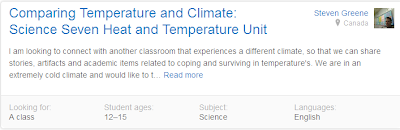
Here is the teacher who responded to the proposed project:
 Each teacher requested each student create a question to be asked to the other class considering the "heat and temperature" theme. This was done a few days in advance and the questions were shared between classes. During the Skype conversation each student would ask their question (standing in front of the webcam) to the other class and the student who was required to answer it would get up and approach the webcam to answer.
So what did I notice?
First of all the students were giddy with excitement before the class started. The teacher did a wonderful job preparing his students including "practice questions" the class before, a conversation on what is is like to be a Canadian ambassador in an effort to make a great impression, rules of engagement etc. The students even took a look at Google Street View to see what the American school looked like.
Second, there was almost no technological issues. The sound was great, the picture very clear and only a slight delay in video because of the volume of internet traffic during that time of the day.
Third, the conversation between classes took about 30 minutes and the amount of learning that took place was significant. Nevermind the great science connections, I was most impressed with the other learning that took place. The school district I work for has a literacy focus and we all struggle as to how to define literacy. I witnessed many forms of developing literacy during the Skype call. For example, some of these literacy components were: communication skills (students had to stand up and communicate clearly) appreciation for cultural differences (Louisiana students didn't know what a toque was or a toboggan), digital literacy (students were comfortable with the technology and knew to source their research).
Fourth, the level of engagement didn't wear off. There was sustained engagement as the students were taking personal responsibility and had choice for the direction of their learning.
This was just the beginning and for a test drive, an amazing success.
I recently had the pleasure of watching two science classrooms Skype together. One classroom was from Edmonton, Alberta and the other from Haughton,Louisiana. The topic was a conversation piece with the theme of "heat and temperature". Here was the project advertised on Skype in the classroom:

Here is the teacher who responded to the proposed project:
 Each teacher requested each student create a question to be asked to the other class considering the "heat and temperature" theme. This was done a few days in advance and the questions were shared between classes. During the Skype conversation each student would ask their question (standing in front of the webcam) to the other class and the student who was required to answer it would get up and approach the webcam to answer.
So what did I notice?
First of all the students were giddy with excitement before the class started. The teacher did a wonderful job preparing his students including "practice questions" the class before, a conversation on what is is like to be a Canadian ambassador in an effort to make a great impression, rules of engagement etc. The students even took a look at Google Street View to see what the American school looked like.
Second, there was almost no technological issues. The sound was great, the picture very clear and only a slight delay in video because of the volume of internet traffic during that time of the day.
Third, the conversation between classes took about 30 minutes and the amount of learning that took place was significant. Nevermind the great science connections, I was most impressed with the other learning that took place. The school district I work for has a literacy focus and we all struggle as to how to define literacy. I witnessed many forms of developing literacy during the Skype call. For example, some of these literacy components were: communication skills (students had to stand up and communicate clearly) appreciation for cultural differences (Louisiana students didn't know what a toque was or a toboggan), digital literacy (students were comfortable with the technology and knew to source their research).
Fourth, the level of engagement didn't wear off. There was sustained engagement as the students were taking personal responsibility and had choice for the direction of their learning.
This was just the beginning and for a test drive, an amazing success.
Friday, 23 September 2011
The Flipped Science Class
The "Flipped Classroom" - very cool.
One of the biggest challenges science teachers in Alberta face is the lack of time to "cover" everything. Sometimes, when I taught, I felt like a machine; marching my students through two sets of curricula. We have a wonderful senior high program of studies in science and when compared with other curricula in North America comes up as one of the best. And, because we offer programs of choice in my school district, some senior highs also offer International Baccalaureate and/or Advanced Placement programs. So the teacher has to meet the demands of two curricula. This leads to the lecture style of teaching as a dominant form of teaching as the teachers struggle to complete the program.
The concept of a "Flipped Class" seems to me to be the answer to that challenge.
The "flipped classroom" is the brainchild of Jonathan Bergmann and Aaron Sams from Woodland Park, Colorado. Their website explains the "flipped class" at http://learning4mastery.com/
This website showcases Aaron Sams explaining how he flipped his class: http://www.sciencematterswi.com/flipped-classroom
The idea is basically an inversion of traditional teaching. Instead of lecturing during class time and then assigning homework to check for understanding, the teacher assigns a short vodcast (or webcast) of the lesson to be watched at home. The students come to class after watching the lesson and then use class time to complete activities based on the lesson and level of understanding. This provides the teacher with the class time to assess the understanding, and differentiate instruction for every student, every day in every class.
This innovation in teaching practice is the most exciting concept I have heard of in a long time.
One of the biggest challenges science teachers in Alberta face is the lack of time to "cover" everything. Sometimes, when I taught, I felt like a machine; marching my students through two sets of curricula. We have a wonderful senior high program of studies in science and when compared with other curricula in North America comes up as one of the best. And, because we offer programs of choice in my school district, some senior highs also offer International Baccalaureate and/or Advanced Placement programs. So the teacher has to meet the demands of two curricula. This leads to the lecture style of teaching as a dominant form of teaching as the teachers struggle to complete the program.
The concept of a "Flipped Class" seems to me to be the answer to that challenge.
The "flipped classroom" is the brainchild of Jonathan Bergmann and Aaron Sams from Woodland Park, Colorado. Their website explains the "flipped class" at http://learning4mastery.com/
This website showcases Aaron Sams explaining how he flipped his class: http://www.sciencematterswi.com/flipped-classroom
The idea is basically an inversion of traditional teaching. Instead of lecturing during class time and then assigning homework to check for understanding, the teacher assigns a short vodcast (or webcast) of the lesson to be watched at home. The students come to class after watching the lesson and then use class time to complete activities based on the lesson and level of understanding. This provides the teacher with the class time to assess the understanding, and differentiate instruction for every student, every day in every class.
This innovation in teaching practice is the most exciting concept I have heard of in a long time.
 |
Subscribe to:
Posts (Atom)